|
Is
It The Brand or The Movement
Part 3 of 3
by Watchking
Cartier, Turler, Bucherer, Bulgari, Tourneau, Krigel, Roberge, Bailey
Banks & Biddle, Birks, Eatons, Chaumet, Harry Winston, and Tiffany are
just a few of the watch brands that are also the trade names of stores
or store groups whose watches are eminently collectible. These companies
and those like them have had watches of various quality levels made for
them, for years. Some of these companies have purchased or even started
watch manufacturing plants, and a few have had proprietary watches made
for them. These brands of watches are famous not only as timepieces on
their own but also because the myth and mystique of the parent company
is an important factor in the value of many of the watches with these
brands.
While it has been common for jewelry stores to sell watches of their own
"house" brand of watches for many hundreds of years, these store brands
listed above really came into their own during the early 20th Century.
In many ways it was the Ball Watch Company that helped push this trend
along. At the beginning of the 1900s a railroad entrepreneur named Webb
C. Ball decided to "create" a brand of watches that would be as good as
any manufacturers' brand on the market and it was a well known fact that
he also promoted the fact that Ball watches were made by other companies
in the watch business, while emphasizing that his company's watches were
made to "Ball Standards". Webb Ball was instrumental in developing the
US National standards for railroad approved timepieces after a huge
train crash caused many casualties, all because one trainman's watch was
3 minutes different from another trainman's watch on an oncoming train.
Ball railroad watches were almost immediately accepted as being of the
highest quality and as good as any other watch available at the time.
At about the same time Tiffany was promoting the sale of their own brand
of pocket watches made by such world renowned manufacturers as Koehn,
Audemars & Piguet, Vacheron Constantine and Ulysses Nardin. Now-a-days
many of these manufacturers are makers of the most highly respected
watches in the world, but in this era they were much less known outside
their own small corners of Europe. The buyers and merchandisers at
Tiffany recognized these companies as being superlative manufacturers
but the buying public were less aware of this fact in North and South
America and Asia. At this time the brand name of the jewelry store often
enhanced the value of a high grade watch in the eyes of a buyer because
these retailers were known to be selling fine goods and there was also
the added benefit of local repair service at a time when many watch
companies still offered warranty service only if their watches were
shipped back to the factories.
Cartier was one of the most prominent of the "house" brand retailers.
This company even went to the extent of designing their own signature
watch models. Cartier has a very large manufacturing and assembly plant
in Fribourg, Switzerland where jewelry and watches are made, so today
Cartier has succeeded in becoming a vertically integrated distribution
company, making and then selling its own designs of products. While many
of Cartier's own brand of watches were produced for them by other
companies like European Watch Company, their success has allowed
Cartier's to found an atelier capable of producing every grade of watch
from the most basic to the most complicated. Cartier has been careful to
emphasize its own brand and very high standards of quality during the
last 100 years that it has been marketing wristwatches and so its brand
has retained its cache`.
Cartier also designed the watch that can rightly claim to be the longest
produced "sport" watch of all time, the "Santos". Named after a
sportsman whose name was synonymous with "adventure" in his day, the
Cartier Santos watch has stood the test of time. A solidly made watch
that is water resistant and shockproof, the Santos is eminently
collectible as an automatic wind watch. This watch has perhaps inspired
as many or more copies than any other watch in history. It was also a
sports watch that was available in both steel and precious metal.
Cartier has always stood by their watches but the Santos was always a
flagship model and so Cartier made a special effort to keep Santos
owners happy even though many adventurers purchased this model of watch
to take on their "adventures". Today people don't think of the Santos as
being as much a sports watch as a luxury watch in spite of the solidity
of it's construction and the generally heavy weight of this watch.
Modern super waterproof or shockproof watches in steel, graphite and
plastics dominate the sports watch market today. But the Santos was a
special watch that was a true sports watch in an era when most wrist
watches were delicate and prone to failure. The fact that today the
Cartier Santos is recognized as a luxury watch is an indication of just
how collectible this watch is. If you can ever find an automatic wind
Santos in good condition at a reasonable price, it is a great
investment.
Eatons of Canada is also an interesting company brand. This department
store was successful in the 19th and 20th centuries while Canada
developed as a nation. Although currently defunct, there were many high
quality Eatons brand watches sold through its stores. One of the most
famous Eatons watches and one with a huge collector following is the
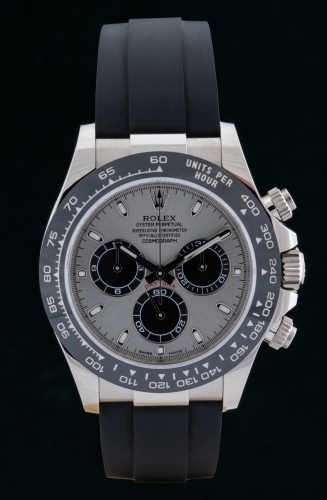
Eaton(Rolex) Quarter Century watches. This watch was made by Rolex for
Eaton's employees who had worked 25 or more years for the company.
Produced for a number of decades, these watches are now highly
collectible and they bring high prices on the open market. In fact this
model of watch is considered an important part of both Eatons and Rolex
product history.
Although many of the retail watch brands mentioned above (like Cartier,
Tiffany, Bulgari and Chaumet) have become synonymous with very expensive
high end watches and are thus eminently collectible, it is often the
less know retail brand of watch that can present the vintage watch
collector with the opportunity to obtain a super high quality watch for
a reasonable price. In this market niche Bucherer stands out (and to a
lesser extent Turler or Tourneau) as a retail company that has sold
thousands and thousands of collectible watches. Bucherer is a chain of
jewelry and gift stores headquartered in Geneve, Switzerland. They sell
the highest quality music boxes, spectacular jewelry, china and most of
all, watches. Being in Geneve puts Bucherer right in the middle of the
watch industry. For many years Bucherer was one of Rolex' largest retail
sellers.
But Bucherer also sold its own brand of watches all through the 20th
century. While many of it's watches were typical manual wind or
automatic watches Bucherer was able to sell a very large number of its
own brand of COSC certified chronometers. The fact that they were
reasonably priced does not take away from their quality. In fact this
often made Bucherer certified chronometers the best value and the
largest selling brand to tourists who came to visit Geneve, hoping to
buy a fine watch at a reasonable price. Bucherer also sold many of their
certified chronometers in solid gold cases with a much lower markup than
the elite watch brands. This is a great boon for collectors who want to
build a collection of certified chronometers. The fact that there are
many, many Bucherer chronometers still available on the market after
30-40 years use is both a tribute the quality of their manufacture and a
benefit to collectors because these watches are not scarce.
Collectors seeking super complicated watches will again benefit from the
retail store brand name on the dial of a watch that may have been
produced by Rolex, Audemars, Patek Philippe, IWC, Lemania or Ulysses
Nardin. Many collectors would like to own certified chronometer watches,
or triple date moonphase models, or mechanical alarm watches or even
repeaters, but can never justify the extremely high prices that many of
the elite brands bring at auction or in vintage watch shops. But these
same kind of high end watches can sometimes be purchased less
expensively with retail store brand names on the dial, even if they were
made by an elite watch company for these retailers. This is especially
true if you want to collect complicated European pocket watches. A
special example of this is the triple date, moonphase chronograph,
automatic wind watch with the Tourneau brand on the dial. Tourneau is
one of the world's largest watch retailers and their own brand of
watches are every bit as good as many of the more well known watch brand
products they sell with the same features for substantially more. Look
at the watch itself, check the movement, consider the warranty service
on a retailer's own brand when you visit that store. In many cases you
will find the retailer's "house" brand is a much better value.
So while in some cases a watch may be more or less collectible depending
on which brand markets a certain movement, in other cases it can be the
movement that makes all the difference. And in the case of watches
marketed by retailers, some watches can represent a special value if the
watch's value is enhanced by the retailers brand (like it is with
Cartier) or if the retailer's brand name makes the watch substantially
more affordable than it might have been with the maker's brand name on
the dial (like it is with Bucherer or Tourneau). So it is a good idea
for collectors to become familiar with the movements which have proven
to be of very high precision and reliability, so if they find one of
these movements in a watch with a less well know brand name they can
recognize its value. Sometimes when the same basic movement is in two
different branded watches one model may be worth substantially more if
the movements are rebuilt or enhancements are added. Sometimes it's the
brand and sometimes it's the movement. Good luck and have fun collecting
watches.

|